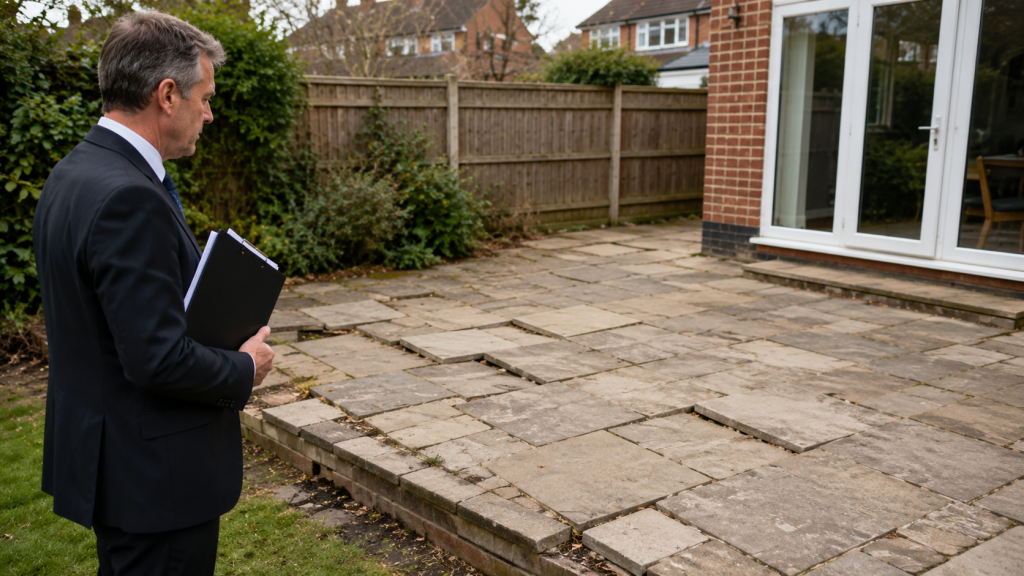
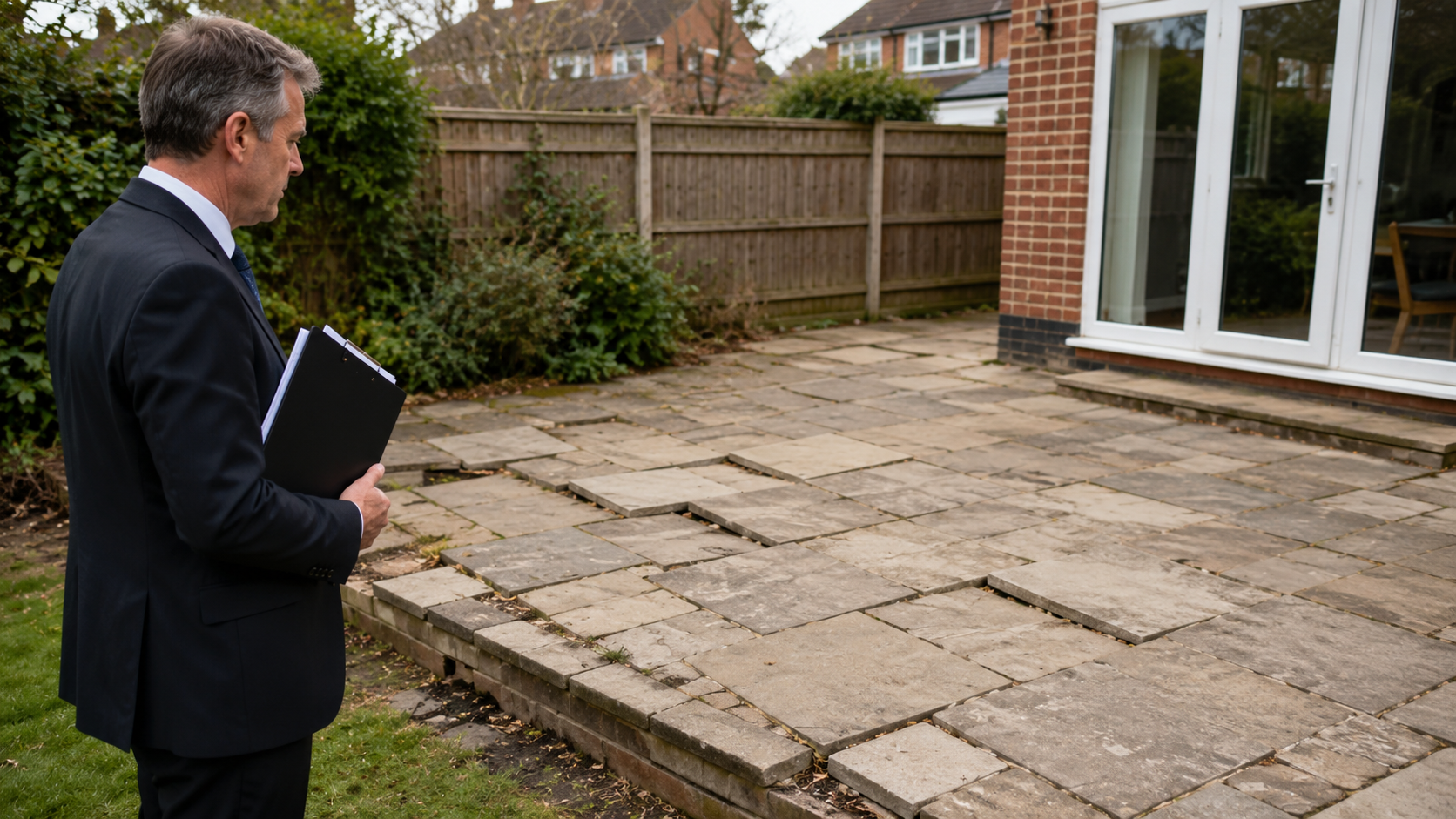
A patio should feel solid underfoot. The paving should remain stable, the joints should stay intact and the finished surface should drain properly. Therefore, when slabs begin to rock, move or become noticeably uneven, it is reasonable for a homeowner to question whether something has gone wrong beneath the surface.
Sometimes the problem is genuinely local. One or two paving units may have lost their bond with the bedding mortar, while the surrounding patio remains sound. In that situation, a competent local repair may be perfectly reasonable.
However, loose, moving or uneven patio slabs can also be the visible symptoms of a much wider construction problem. If the underlying cause affects the patio as a whole, repeatedly lifting and relaying individual slabs may simply conceal the problem for a while.
The important question is not simply, “Can this slab be repaired?”
It is: “Why has the slab moved in the first place?”
That distinction can determine whether a relatively straightforward repair is appropriate or whether part, and sometimes all, of the patio needs rebuilding.
A loose paving slab is a symptom, not a diagnosis
When somebody walks across a patio and feels a slab move beneath their feet, the natural assumption is that the slab simply needs sticking back down.
Unfortunately, paving construction is rarely that simple.
A professionally constructed patio is a system of several components working together. The paving itself is only the finished surface that you can see. Beneath it should be an appropriate bedding layer, a properly prepared and compacted supporting base, and suitable ground preparation for the particular site.
The paving must also bond correctly to the bedding material. Manufacturers of porcelain and many natural stone products require suitable priming or bonding systems as part of their installation guidance.
If one of those elements fails, movement may eventually become visible at surface level.
Therefore, lifting a loose slab and putting it back down does not necessarily resolve the problem. Before deciding upon a repair, somebody needs to understand why the bond or support failed.
Why do patio slabs become loose or start moving?
There is no single cause that explains every moving patio.
In practice, several defects can produce very similar symptoms. Occasionally there may also be more than one failure occurring at the same time.
Poor bonding between the slab and bedding mortar
A paving unit needs adequate contact and bond with the material supporting it.
If that bond is poor, the paving can separate from the bedding beneath. You may notice movement underfoot, failed joints around the slab or a hollow sound when the paving is tapped.
Porcelain paving requires particular attention because it has very low water absorption. Suitable slurry primers or bonding products therefore form an important part of many manufacturers’ installation systems.
A paving slab that has detached because the correct bonding procedure was not followed presents a very different problem from a single slab damaged by an isolated event.
If the same installation method was used across the whole patio, other slabs may eventually display similar symptoms.
An inadequate or inconsistent bedding layer
The bedding beneath paving should provide continuous and reliable support.
Problems can arise where slabs have been laid on isolated spots or patches of mortar rather than an appropriate full supporting bed. Voids can leave sections of paving inadequately supported, while inconsistent bedding thickness can contribute to instability.
The effects may not always appear immediately.
A patio can initially look attractive because the upper surface has been carefully aligned. However, regular use, weather and seasonal conditions can gradually expose weaknesses underneath.
Once movement begins, the jointing around the paving often suffers as well.
Problems with the sub-base
The paving and mortar cannot perform properly if the construction beneath them is unstable.
A sub-base normally has to spread loads and provide a firm, consistent platform for the paving construction above. Its required depth and specification will depend upon site conditions and intended use.
Problems can develop where unsuitable material has been used, the formation has not been properly prepared or the sub-base has not received adequate compaction.
Variable construction can also matter.
If one section contains a substantial, well-compacted base while another has only a shallow layer over disturbed ground, the patio may not behave consistently. Settlement can then produce changes in level that appear at the finished paving surface.
This is one reason why investigating causation matters before simply replacing the visibly affected slabs.
Uneven paving does not always mean the same thing
Homeowners often describe paving as “uneven”, although that description can refer to several different conditions.
A single slab may have moved vertically in relation to its neighbour. Alternatively, a complete area may have settled, creating a depression. Individual units might also have been installed at inconsistent levels from the outset.
These circumstances require different conclusions.
Small variations in natural materials can sometimes be part of the character of the paving. However, pronounced changes in level can become unsightly, affect drainage or create a potential trip hazard.
The timing can also provide useful evidence.
If a newly completed patio is noticeably uneven from day one, installation accuracy may be the principal concern. If previously aligned paving begins changing several months or years later, the investigation should consider what has allowed that movement to develop.
The visible difference in level therefore tells only part of the story.
What do cracked or failed patio joints tell you?
Jointing failure frequently accompanies paving movement.
When paving units move independently, the material between them can crack, separate or break away. Replacing the jointing may improve the appearance temporarily, but it will not stop movement underneath.
This is where homeowners can become trapped in repeated repairs.
The jointing fails, so somebody replaces it. A few months later it cracks again, another slab begins rocking and a second repair follows.
At that point, the recurring joint failure should prompt a more important question:
Is the jointing itself defective, or is it repeatedly failing because the paving beneath it is moving?
A successful repair should address causation rather than continually treating the visible symptom.
When can loose patio slabs reasonably be repaired?
Not every loose slab means that the entire patio needs removing.
A local repair can be entirely appropriate where the defect is genuinely isolated and the surrounding construction remains sound.
For example, investigation might establish that one or two slabs have suffered an isolated bond failure. The remaining paving may be stable, correctly supported and free from widespread movement.
In circumstances such as these, a competent contractor may be able to carefully lift the affected paving, remove unsuitable bedding material and reconstruct the local area correctly.
However, that decision should follow an assessment of the surrounding patio.
Before recommending local repair, I would want to understand whether adjacent paving is also moving, whether there are widespread hollow areas, whether levels remain satisfactory and whether the failure mechanism appears confined to the affected location.
The condition of the rest of the patio matters far more than the number of visibly loose slabs.
When should you start questioning whether local repairs are enough?
The case for isolated repair becomes weaker when the defects occur repeatedly or across several locations.
Suppose five slabs are loose today, another four sound hollow and jointing has already failed in several areas. Repairing only the five moving slabs may make the patio usable temporarily, but it has not necessarily resolved the underlying installation problem.
The same concern arises where levels vary substantially across the patio or where different sections appear to have settled.
Warning signs that the problem may extend beyond one loose slab
- Slabs are moving in several separate areas of the patio.
- Several paving units sound hollow when checked.
- Jointing has cracked, separated or repeatedly failed.
- The surface appears to be settling or changing level.
- Cracking is appearing across multiple locations.
- Lifted slabs reveal poor, incomplete or inconsistent bedding.
- There is evidence of inadequate bonding or primer coverage.
- Standing water has developed alongside changes in paving levels.
- Previous local repairs have subsequently failed again.
None of these points automatically proves that complete reconstruction is necessary. However, taken together, they can indicate that the problem extends beyond one isolated paving unit.
Why lifting one slab can sometimes reveal much more
Opening up a carefully selected area can provide extremely useful information.
Once a paving unit has been lifted, the construction beneath becomes visible. It may then be possible to assess the bedding material, bonding, coverage, thickness and general condition.
Depending upon the investigation, further opening-up may also help establish how the supporting layers have been constructed.
This physical evidence can be considerably more useful than assumptions made from photographs alone.
For example, a photograph can clearly show a rocking paving slab. It cannot necessarily establish whether the slab has detached from an otherwise suitable mortar bed, whether the bed itself is defective or whether movement originates further down in the construction.
That distinction matters when deciding what needs to be repaired.
What if the contractor offers to simply re-lay the loose slabs?
A contractor should normally have a reasonable opportunity to inspect a problem and respond to a complaint.
Equally, homeowners should understand what the proposed repair is intended to achieve.
If a contractor proposes lifting three loose slabs and relaying them, ask why those slabs became loose. You should also ask whether the surrounding paving has been checked and whether the proposed repair addresses the underlying cause.
A sensible remedial proposal should explain more than the physical act of replacing paving.
It should explain why the failure occurred and why the proposed work should prevent it happening again.
Where the contractor can demonstrate an isolated defect and provide a technically sound repair, local remediation may be the proportionate solution.
However, repeated patch repairs become harder to justify where evidence suggests the original construction method itself is defective.
When might a patio need rebuilding?
Complete reconstruction should not be recommended lightly.
Removing an otherwise serviceable patio creates significant cost, disruption and waste. Therefore, there should be a sound technical reason for concluding that local repair cannot provide a reliable remedy.
Rebuilding becomes more likely where the defects are systemic.
That might include widespread inadequate bedding, poor bond across large areas, insufficient or inconsistent support beneath the patio, significant settlement, defective levels or several interacting construction failures.
The practical question then becomes whether enough of the existing construction can reasonably be retained.
Sometimes a substantial section can remain while another area requires reconstruction. In other circumstances, defects may extend throughout the installation and leave no sensible boundary for localised remediation.
Every project needs to be considered on its evidence.
The objective should always be to identify the least extensive remedial work that can reasonably provide a durable and technically satisfactory result.
Local repair may be reasonable when:
- The defect is genuinely isolated.
- Adjacent paving remains stable.
- There is no evidence of widespread settlement.
- The surrounding bedding and support appear sound.
- The cause can be clearly identified and corrected.
- The proposed repair addresses the cause rather than the symptom alone.
Wider rebuilding may need consideration when:
- Movement occurs across several areas.
- There is widespread poor bonding or bedding.
- Levels have changed significantly.
- The supporting construction is inconsistent or inadequate.
- Previous repairs have repeatedly failed.
- There is no sensible boundary between sound and defective work.
Be cautious about judging a patio from photographs alone
Photographs are useful evidence, especially when they record changes over time.
Videos showing movement can be particularly helpful. Original construction photographs may also reveal details that are no longer visible.
Nevertheless, there are limitations.
A photograph of an uneven patio can demonstrate its appearance. It does not necessarily establish the depth of the supporting construction, the condition of the bedding or the reason movement occurred.
Consequently, a reliable technical opinion may require measurements, physical inspection and, where appropriate, carefully controlled opening-up.
That becomes increasingly important where the cost of remedial work is substantial or the contractor and homeowner disagree about responsibility.
What should you do if your patio slabs are moving?
Start by recording what is happening before anything gets taken apart.
Photograph the affected areas clearly and take videos where movement is visible. It can also help to record when you first noticed the problem and whether it appears to be getting worse.
Then look at the patio as a whole rather than concentrating solely on the worst slab.
Homeowner checklist before repairs begin
- Photograph every area where slabs appear loose, uneven or cracked.
- Record video where movement can be demonstrated safely.
- Keep photographs taken during the original construction if you have them.
- Note where jointing has failed and whether it has failed before.
- Record areas where water now collects or drains poorly.
- Keep the contractor’s quotation, specification, invoice and correspondence.
- Retain manufacturer information for the paving and jointing products where available.
- Tell the original contractor about the problem in writing.
- Understand the proposed cause and repair before extensive work begins.
- Consider independent assessment before evidence is removed where the defect is disputed or appears widespread.
If the work is relatively recent, notify the original contractor in writing and give them an opportunity to inspect it.
Avoid authorising extensive destructive work until you understand what is being proposed. Once paving and bedding materials have been removed, potentially useful evidence about the original construction may disappear with them.
Where the problem remains disputed or appears widespread, an independent technical assessment can help establish the position before substantial remedial work begins.
Repair or rebuild? The answer depends upon the cause
A loose patio slab does not automatically mean that you need a new patio.
Equally, repeatedly sticking down slabs does not transform a defective installation into a sound one.
The correct solution depends upon what has failed, why it failed and how far the problem extends.
A genuinely isolated bond failure may need nothing more than a competent local repair. Widespread movement caused by defective construction may require considerably more intervention.
That is why diagnosis should come before remediation.
If your patio is moving, uneven or repeatedly requiring repairs, the useful question is not simply how many slabs are loose today.
It is whether the construction beneath them provides a sound basis for the patio you expected to receive.